Full moon behind Mount Etna
Computed from Taormina, looking south-west along the coast, 28.1 km from the summit, against the real ridge line, not a flat horizon. (37.8530, 15.2870)
The next full moon behind Etna from this viewpoint is Tuesday 20 April 2027 at 04:39 CEST, ≈6.5 moon-widths above the summit (+3.4°) and setting.
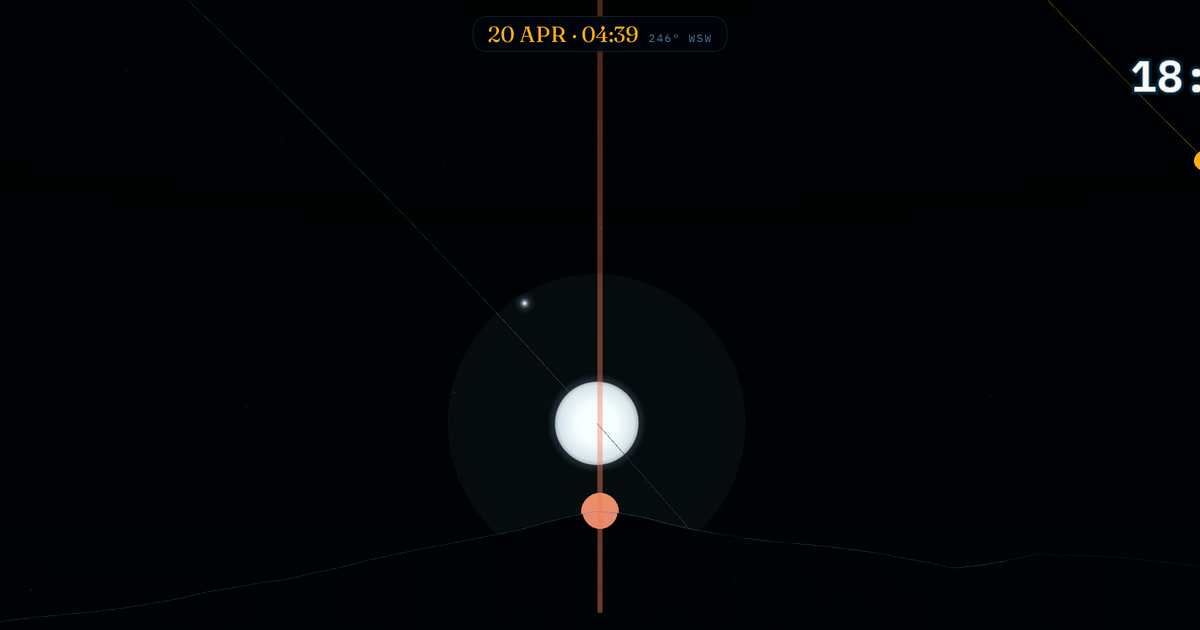
Free, in the browser. The sky view opens at this minute, from this spot, with the real ridge line. Drag the pin to your own spot and the whole schedule recomputes.
Upcoming line-ups (next 18 months)
| Date | Time | Moon | Height over summit | Motion | Preview |
|---|---|---|---|---|---|
| 20 Apr 2027 | 04:39 | 99% | ≈6.5 moon-widths above the summit (+3.4°) | setting | See it in 3D → |
| 17 Aug 2027 | 05:28 | 100% | ≈2.6 moon-widths above the summit (+1.3°) | setting | See it in 3D → |
| 07 May 2028 | 03:54 | 96% | sitting on the summit (+0.2°) | setting | See it in 3D → |
All times are local to the viewpoint (Europe/Rome). Scan window 10 Nov 2026 to 11 May 2028. Months not listed have no line-up: the moon crosses this bearing most nights, but rarely full and at ridge height.
Not every full moon lines up. The closest call before then is 23 March 2027: the full moon crosses the summit's bearing at 04:45 CET, but 8.5° above the summit (about 16 moon-widths), so it misses.
Questions
- What does "behind Etna" mean exactly?
- Each row is a minute when the full (≥95%) moon crosses the exact bearing from the viewpoint to the summit, within a few degrees above the summit. From 28.1 km away the moon still spans its usual 0.52°, about one fingernail at arm's length, so framing moon and summit together wants a long lens (300 mm+ on full frame; the smaller the row's "height over summit", the tighter the shot).
- Why does terrain matter?
- A mountain horizon sits degrees above the geometric one. Times computed against a flat horizon can be tens of minutes off, or list nights where the moon never clears the ridge at all. These rows are gated against a 360° elevation ray-cast from the viewpoint.
- Is the moon rising or setting in these shots?
- The Motion column says. A rising line-up means shooting after moonrise (usually evening); a setting one often means a pre-dawn session, so plan the hike accordingly.
- What if my spot is different?
- Move the pin. Every preview link opens Heliora with this viewpoint and target pre-set. Drag the pin to your own spot and the scanner recomputes the whole schedule for it, free, in the browser.
Method
Geometry from astronomy-engine (±1 arcminute, ΔT-corrected). Terrain from AWS Terrarium elevation tiles, ray-cast 360° from the viewpoint (37.8530, 15.2870); the summit (246° WSW) is read from the highest of the elevation cells around it at ~30 m resolution. Hits require ≥95% illumination, the moon's centre clear of the terrain, and the moon no more than 4° above the summit. Times are local to the viewpoint. Accuracy notes: heliora.app/method.